Support reaction loads
The Support reaction loads panel is part of Exertion and displays the reaction forces and moments at the model’s contacts with the floor or another support surface.
These reactions maintain equilibrium in the analyzed posture. They depend on posture, body weight, applied loads, seated condition, and detected supports.
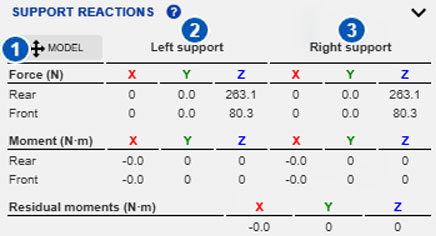
| No. | Area or control | Function |
|---|---|---|
| 1 | Reference system | Switches between the model’s local reference system and the global reference system. |
| 2 | Left support | Displays X, Y, and Z reaction forces and moments for the left support. |
| 3 | Right support | Displays X, Y, and Z reaction forces and moments for the right support. |
Purpose of the panel
The panel shows how loads generated by the body and external forces are transmitted to the floor or support surface.
In standing postures, supports are usually the feet. In seated or other situations, detected supports can also be the:
- feet;
- knees;
- hips;
- other contacts considered by the model.
The panel therefore represents reactions at the supports detected for the current posture, not only beneath the feet. To review detected support types, see Stabilogram.
Reference system
Control 1 changes the reference system used for forces and moments.
By default, values use the model’s local reference system, which moves and rotates with the model and facilitates interpretation relative to the body.
The button switches to the fixed global reference system. X, Y, and Z are then interpreted relative to the scene axes rather than the model.
A reaction can have different components in the two systems. Rotating the complete model changes global components even when relative body posture is equivalent.
As a general rule:
- use the model reference system to interpret reactions relative to the body;
- use the global reference system to interpret reactions relative to the scene.
Left and right supports
Columns 2 and 3 display the reactions at the left and right supports as X, Y, and Z force and moment components.
The meaning of left and right depends on the detected support. In standing, they normally correspond to the left and right feet. In seated or alternative supports, they can correspond to equivalent lateral supports such as the left and right hip or knee.
Reaction forces
Force (N) displays support reactions in newtons.
They represent the action exerted by the floor or support surface to balance body weight, external loads, and posture.
Rows can distinguish areas such as Rear and Front, representing reaction distribution within a support—for example, between the rear and front of a foot.
The Z component is usually particularly relevant to vertical reaction against body weight and vertical loads. X and Y represent horizontal or lateral reactions relevant to pushing, pulling, load displacement, or possible slipping.
Reaction moments
Moment (N·m) displays support reaction moments.
They represent rotational tendencies produced by force distribution, center-of-pressure position, and posture geometry.
These values can be low or zero when distributed support forces can fully balance the posture without relevant residual moments. Asymmetric postures, external loads, or displaced supports can produce appreciable reaction moments.
Interpret them together with:
- the support base;
- center-of-gravity position;
- weight distribution;
- detected support type;
- external loads.
See Stabilogram.
Residual moments
Residual moments (N·m) displays moments not fully balanced by the reactions distributed among the represented supports.
A residual moment means that the model and support configuration could not completely assign one moment component to the calculated left and right support reactions. Causes can include:
- the posture result is not perfectly balanced by available supports;
- the support base or support distribution is limited;
- external loads produce an additional moment;
- the posture is near instability;
- the model must balance part of the moment through a global residual reaction;
- biomechanical-model or contact-representation simplifications.
A low or zero residual moment indicates that equilibrium is adequately distributed among the considered supports. Review a high value because it can indicate that the posture, supports, or entered loads need checking.
Do not interpret residual moments in isolation. Consider them together with the stabilogram, support base, and joint loads.
Relationship with stability
Support reactions are directly related to posture stability.
For a stable posture, resultant forces and moments must be balanced within the support base. If the projected center of pressure or resultant falls outside it, the posture can be unstable.
The Stabilogram displays:
- support base;
- center of gravity;
- center of gravity including external loads;
- weight distribution among supports;
- detected support type;
- slipping.
Review the stabilogram when this panel shows high reactions or residual moments.
Relationship with seated posture
Seated posture can substantially change support-reaction interpretation.
Standing reactions normally concentrate at the feet. In seated posture, contacts can involve the feet, knees, thighs, or pelvis. Backrest does not add a support point or generate its own reaction.
Enabling or disabling the backrest can change certain torso moments and exertions but should not itself redistribute support reaction forces.
Before interpreting reactions, determine whether the posture is seated. See:
Review both automatically detected and manually assigned seated conditions for consistency with the actual task.
Relationship with external loads
Loads applied at the hands or other body segments can change support reactions.
A forward load can move the resultant toward the front of the supports. A lateral load can increase one side’s reaction. A horizontal force can increase X or Y and affect slipping.
Review:
Difference from joint loads
Support reaction loads are external reactions at contact points; they are not internal joint loads.
| Panel | What it displays | Primary use |
|---|---|---|
| Support reaction loads | Reaction forces and moments at floor or support contacts. | Interpret stability, weight distribution, and external equilibrium. |
| Joint loads | Estimated internal forces and moments at joints. | Interpret mechanical load transmitted through the body. |
See Joint loads.
Practical interpretation
- Check the active reference system.
- Review the detected support type under Stabilogram.
- Examine force distribution between the left and right supports.
- Review vertical and horizontal reaction components.
- Check for relevant reaction moments.
- Review residual moments.
- If values appear inconsistent, check posture, seated condition, external loads, and contact tolerance.
- Compare the results with joint loads and posture stability.
Recommendations for use
- Do not interpret reactions before checking the detected supports.
- Review seated posture when supports are not limited to the feet.
- Do not directly compare X, Y, and Z components obtained under different reference systems.
- Use the stabilogram to interpret load distribution and stability.
- Review external loads when horizontal components are high.
- If residual moments are important, review posture and support consistency.
Related manual sections
- Exertion
- Joint loads
- Stabilogram
- Seated posture
- Load or force at the hands
- Loads on body segments
- Model parameter settings
- Intelligent menu
Relationship with the Technical foundations
For methodological details, see:
- Support modeling
- Foot-support reaction forces while standing
- Stabilogram and support-reaction distribution
- Support base, center of pressure, and stability
- Joint-load calculation
- Joint loads
- Modeling seated posture on a chair
- Distribution of support reactions while seated on a chair
- Limitations in calculating biomechanical moments and exertion
These sections explain support modeling, reaction calculations, stability, and biomechanical-analysis limitations.