Postural load: LUBA
The LUBA assessment panel is part of the Postural load dialog and displays the results of the postural-load assessment using the LUBA method.
LUBA, an acronym for Loading on the Upper Body Assessment, is a method primarily intended to assess postural load on the upper body. In Ergoniza Intelligent, the LUBA panel displays discomfort scores by body segment and movement, discomfort indices for the right and left sides, action categories, and the recommended action.
For an overview of the complete dialog, see Postural load.
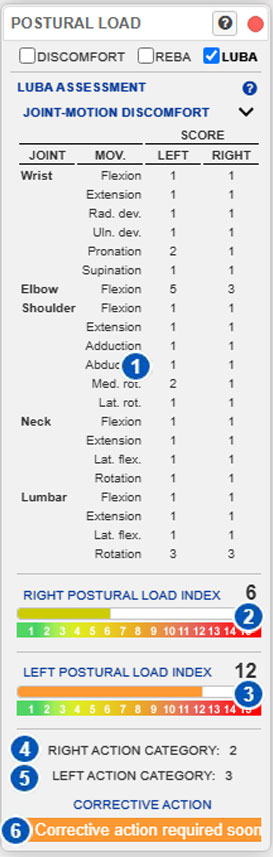
| No. | Area or control | Function |
|---|---|---|
| 1 | Joint-motion discomfort | Displays the discomfort score by body segment and degree of freedom for the left and right sides. |
| 2 | Right postural load index | Displays the LUBA discomfort index for the right side. |
| 3 | Left postural load index | Displays the LUBA discomfort index for the left side. |
| 4 | Right action category | Displays the LUBA action category obtained for the right side. |
| 5 | Left action category | Displays the LUBA action category obtained for the left side. |
| 6 | Corrective action | Displays the recommended action based on the LUBA result. |
Purpose of the LUBA panel
The LUBA assessment panel assesses upper-body postural load using the LUBA method.
The method assigns scores to different body segments and movements. From these scores, Ergoniza Intelligent calculates discomfort indices for the right and left sides, assigns an action category, and displays a recommended action.
LUBA is particularly useful for reviewing postural demand affecting the:
- wrist;
- elbow;
- shoulder;
- neck;
- lumbar region.
Unlike some other indicators, LUBA clearly separates results for the right and left sides. This is relevant for asymmetric tasks in which one side can adopt more demanding postures than the other.
Joint-motion discomfort
Area 1 displays the Joint-motion discomfort panel.
It contains the scores assigned to the body segments and movements considered by LUBA. For each joint or body region, the table displays the assessed movements and corresponding scores for the left and right sides.
The panel is collapsed by default. Select the Joint-motion discomfort heading to expand it.
Use the table to identify the body segment and movement contributing most to the final discomfort index. For example, if one side has a high index, review the partial scores for that side to locate the main cause.
These scores belong to the LUBA method and are not equivalent to the postural-discomfort percentages shown under Postural load: Discomfort. Although the concepts are related, they use different calculation models.
Right postural load index
Area 2 displays the postural load index for the right side.
This index summarizes the postural load calculated by LUBA for the right side from the partial scores for the body segments and movements considered by the method.
The graphical indicator below the index supports visual interpretation. Lower values indicate less postural load. Higher values indicate greater demand and a greater need to review the posture or task.
Left postural load index
Area 3 displays the postural load index for the left side.
It is interpreted in the same way as the right index but applies to the left side. Comparing the two indices helps identify postural asymmetry.
If the left index is substantially higher than the right, review the left-side body segments or movements with higher scores in the Joint-motion discomfort panel. Do the converse if the right index is clearly higher.
Action categories
Areas 4 and 5 display the action categories assigned by LUBA.
Number 4 is the action category for the right side.
Number 5 is the action category for the left side.
These categories convert the discomfort index into a more operational interpretation. The higher the category, the greater the need to consider task improvement or redesign.
Separate categories for the right and left sides are important in asymmetric tasks. One side can have an acceptable category while the other has a less favorable one.
Corrective action
Area 6 displays the corrective action recommended from the LUBA result.
This indication summarizes the practical recommendation associated with the obtained indices and action categories. Interpret it as ergonomic guidance, not as an isolated automatic decision.
Before deciding on an action, review:
- whether the model posture correctly represents the actual task;
- whether task loads and conditions are defined correctly;
- whether the posture is momentary, sustained, or repetitive;
- whether there are relevant differences between the right and left sides;
- which specific body segments and movements explain the result.
Differences from Discomfort and REBA
Do not interpret the LUBA panel as equivalent to the Discomfort or REBA panels.
- Postural load: Discomfort displays percentages by body segment and movement under the Ergoniza Intelligent postural-discomfort model.
- Postural load: REBA displays a postural-risk assessment under the REBA method, with body groups A and B and an overall score.
- LUBA displays a postural-load assessment based on LUBA rules and distinguishes the right and left sides.
The results therefore need not be identical. Each method has different criteria, scales, and purposes.
LUBA is particularly useful for assessing upper-body postural load and detecting asymmetries between the two sides.
Interpretation recommendations
To interpret the LUBA panel:
- First review the right and left postural load indices.
- Compare the two sides to identify possible asymmetries.
- Review the action category for each side.
- Expand Joint-motion discomfort to identify the joints or movements explaining the result.
- Review the corrective action.
- If a result is unexpected, check the model posture, entered loads, and task configuration.
Do not interpret the LUBA index as a percentage. It is a method-specific score and must be read together with the action category and corrective action.
Related manual sections
For further information, see:
- Postural load
- Postural load: Discomfort
- Postural load: REBA
- Action duration and repetitiveness
- Activity repetitions
Relationship with the Technical foundations
For a more complete methodological explanation, see these sections in the Technical foundations:
- Risk assessment of adopted postures using the REBA and LUBA methods
- Risk assessment for unsuitable postures using LUBA
- Postural-risk assessment using REBA
- Postural discomfort
- Conceptual differences between single-posture and multiple-posture analysis
These sections explain LUBA’s methodological basis, its relationship with other postural-assessment methods, and the limits on interpreting its results.