Action duration and repetitiveness
The Action duration and repetitiveness dialog specifies how the assessed posture is interpreted over time in Single posture mode.
Open it with Times in the left-side menu. Its options affect how Ergoniza Intelligent calculates certain biomechanical and postural-discomfort results for a single posture. They do not apply in the same way to complete multiple-posture activities, where duration and repetition are represented by the posture sequence itself.
This selection matters because the same posture has a different ergonomic meaning when it occurs momentarily, is sustained for a period, or forms part of a repetitive cycle.
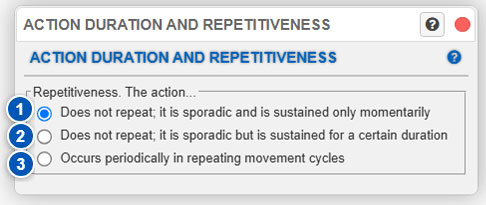
| No. | Option | Intended use |
|---|---|---|
| 1 | Does not repeat; it is sporadic and is sustained only momentarily | Use when the posture represents a momentary action without sustained exposure or relevant repetition. |
| 2 | Does not repeat; it is sporadic but is sustained for a certain duration | Use when the posture is not part of a repetitive cycle but is sustained for a defined period. |
| 3 | Occurs periodically in repeating movement cycles | Use when the posture or exertion occurs within repetitive work cycles. |
Scope of this dialog
This dialog concerns the temporal interpretation of a single posture. It does not define an animation or complete work sequence; it specifies how the action represented by the current posture is to be considered.
The selection primarily affects:
- biomechanical-exertion calculation for a single posture;
- interpretation of exertion according to sustainment time;
- calculation of postural discomfort for momentary, sustained, or repetitive postures;
- exposure weighting when the action is part of a repeated cycle.
For an activity composed of several postures or a time-based animation, use the posture-sequence tools. This dialog is intended for an individual posture that must be identified as momentary, sustained, or repetitive.
Option 1: sporadic action sustained only momentarily
Select Does not repeat; it is sporadic and is sustained only momentarily when the posture represents an isolated time point in the task.
It is appropriate when:
- the action occurs only momentarily;
- the posture is not sustained for a relevant duration;
- there is no periodic repetition;
- an instantaneous or short-duration situation is being assessed.
Ergoniza Intelligent then interprets the posture as a momentary action. No additional duration is entered, and the posture is not considered part of a repetitive cycle. Use this option when the primary interest is the instantaneous effect of the posture or applied load.
Do not use it when the posture is sustained for several seconds or minutes or is part of a repetitive task. Temporal exposure can change how exertion and discomfort are interpreted.
Option 2: sporadic action sustained for a certain duration
Select Does not repeat; it is sporadic but is sustained for a certain duration when the posture does not repeat periodically but is sustained for a defined time.
The dialog then displays additional controls for action duration, which is used to interpret the temporal effect of sustaining the posture.
It is appropriate when:
- the posture is sustained for a defined period;
- the action is not part of a repetitive cycle;
- sustained posture or exertion can cause fatigue or discomfort;
- a static or quasi-static exposure is being assessed.
Examples include holding a tool in a given position, holding a load for a limited interval, remaining bent during a specific operation, or sustaining a work posture while performing a nonrepetitive action.
Enter a duration consistent with the real task. A duration that is too short can approximate a momentary assessment; an excessive duration can represent a more severe exposure than actually occurs.
Option 3: periodic action in repeating cycles
Select Occurs periodically in repeating movement cycles when the assessed posture or exertion recurs within a work cycle.
The dialog then displays additional controls for the cycle’s temporal structure: cycle duration, duration of the action within the cycle, and the number of actions per cycle.
It is appropriate when:
- the action is part of a repetitive work cycle;
- the same posture or exertion occurs several times;
- exposure cannot be interpreted as one continuous sustainment;
- the percentage of cycle time occupied by the action must be considered.
Ergoniza Intelligent calculates the proportion of the cycle occupied by the assessed action and uses it to adapt the biomechanical and postural interpretation of exposure.
Define the cycle carefully so that it represents the real activity. Incorrect cycle duration, action duration, or number of occurrences can make the result unrepresentative of the task’s temporal load.
Relationship with biomechanical calculation
For a single posture, this configuration determines how the exertion associated with the current posture is interpreted.
A momentary posture is treated as an instantaneous situation. For a sustained posture, action duration is included. For a posture in a repetitive cycle, the system considers the proportion of cycle time occupied by the action.
Before interpreting biomechanical results, verify that the selected option represents how the action actually occurs at the workstation.
Relationship with postural discomfort
The repetitiveness configuration also affects postural-discomfort interpretation for a single posture.
A posture adopted for an instant is not equivalent to one that is sustained. Similarly, a posture occurring repeatedly within a cycle can produce a different exposure from an isolated action.
The dialog therefore distinguishes:
- discomfort associated with a momentary posture;
- discomfort associated with a posture sustained for a period;
- discomfort associated with a posture within a repetitive action.
For the methodological details, see these sections in the Technical foundations:
- Recommended percentage of maximum voluntary contraction for single-posture analysis
- Recommended MVC for momentary exertions
- Recommended MVC for static exertions
- Recommended MVC for repetitive tasks
- Postural discomfort
- Details of postural-discomfort calculation for momentary or unsustained postures
Selection recommendations
Select the first option for a momentary posture or exertion with no relevant duration.
Select the second when the posture does not repeat but is sustained for a known interval.
Select the third when the posture or exertion forms part of a cyclic task and occurs repeatedly.
Before closing the dialog, verify that the selection represents the actual situation. It can materially change the assessment of exertion and discomfort.
Common errors
Do not use the momentary-action option for a posture sustained for a meaningful duration. Select the sustained-action option and enter its duration.
Do not use the sustained-action option for a repetitive task in which the posture occurs periodically within cycles. Select the repeating-cycle option and define the corresponding times.
Do not enter arbitrary times. Action duration, cycle duration, and number of occurrences must represent the observed or measured task.
If sufficient temporal information is unavailable, state this limitation when interpreting the results. The results should then be understood as an estimate conditioned by the available information.