8 JOINT LOAD CALCULATION
When maintaining a posture, the joints must support loads caused by the weight of the body segments and by external forces, loads, or moments applied to the model. These loads are transmitted along the kinematic chains and appear at the joints as forces and moments.
For equilibrium to exist—assuming that the posture remains static—reaction forces and moments arise at the joints with the same magnitude as, and in the direction opposite to, the loads they support.
For equilibrium to exist, assuming that the posture remains static, the sum of the forces and moments must be zero. Therefore, a reaction force and moment arise at each joint with the same magnitude as, and in the direction opposite to, the resultant of the loads transmitted by the body segments.
The moment generated by a force about a joint is obtained from the cross product of the position vector from the joint to the point of application of the force and the force vector. Using this relationship and the equilibrium equations, Ergoniza Intelligent calculates the forces and moments transmitted by each joint.
Figure 31 uses the wrist and elbow joints as examples. The external load (C) and the hand's own weight (Ppm) act on the hand. To simplify the representation, both forces are considered to act at the hand's center of gravity (CdGm).
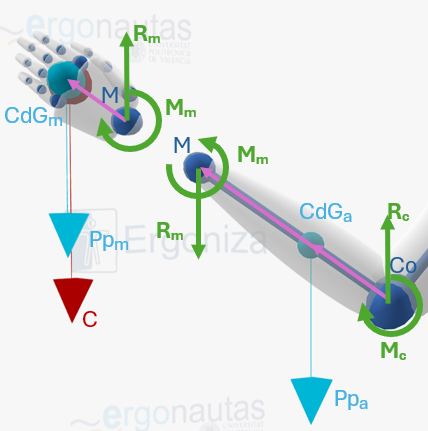
Figure 31: Calculation of the forces and moments transmitted by the wrist and elbow joints.
In the following equations, \({\overrightarrow{r}}_{A \rightarrow B}\) represents the position vector from point A to point B. The calculation uses the resultant force and moment transmitted from the distal segment to the proximal segment; the reactions that maintain equilibrium have the same magnitude and opposite direction. At the wrist, the resultant force Rm is the sum of the external load C and the hand's own weight Ppm, while Mm is obtained by adding the moments produced by both forces about the joint. These relationships are expressed in Equation 2.
\[\overrightarrow{Rm} = \overrightarrow{C} + \overrightarrow{{Pp}_{m}}\]
\[\overrightarrow{Mm} = {\overrightarrow{r}}_{M \rightarrow {CdG}_{m}} \times \overrightarrow{C} + {\overrightarrow{r}}_{M \rightarrow {CdG}_{m}} \times \overrightarrow{{Pp}_{m}}\]
Equation 2
A similar procedure is used to calculate the force Rc and moment Mc transmitted by the elbow, now analyzing the forearm. This segment is acted on by the load transmitted from the hand through the wrist, the forearm's own weight (Ppa), and the moment transmitted by the wrist (Mm).
Again assuming that the posture remains static and applying the laws of equilibrium, the values of Rc and Mc can be determined using Equation 3.
When the equilibrium equations are applied to the forearm, the resultant force Rc is obtained by adding the load transmitted by the wrist and the forearm's own weight. Moment Mc also includes the moment transmitted by the wrist and the moments produced by both forces about the elbow. These relationships are expressed in Equation 3.
\[\overrightarrow{Rc} = \overrightarrow{Rm} + \overrightarrow{{Pp}_{a}}\]
\[\overrightarrow{Mc} = \overrightarrow{Mm} + {\overrightarrow{r}}_{Co \rightarrow M} \times \overrightarrow{Rm} + {\overrightarrow{r}}_{Co \rightarrow {CdG}_{a}} \times \overrightarrow{{Pp}_{a}}\]
Equation 3
This procedure can be applied successively along the entire kinematic chain. Once the force and moment transmitted by the elbow are known, those corresponding to the shoulder can be calculated, and the same process can continue with the joints located closer to the torso.