6 BASE OF SUPPORT, CENTER OF PRESSURE, AND STABILITY
The center of pressure (CoP) is the point of application of the resultant reaction forces exerted by the floor on the supports. Ergoniza Intelligent calculates its position on the floor plane from force and moment equilibrium, accounting for body weight, external loads or forces applied at the hands, and external moments applied at them. When none of these loads, forces, or moments acts, the CoP coincides with the vertical projection of the body center of mass (BCM). Figure 11 shows a situation in which the two positions do not coincide because of a load held in the hands.
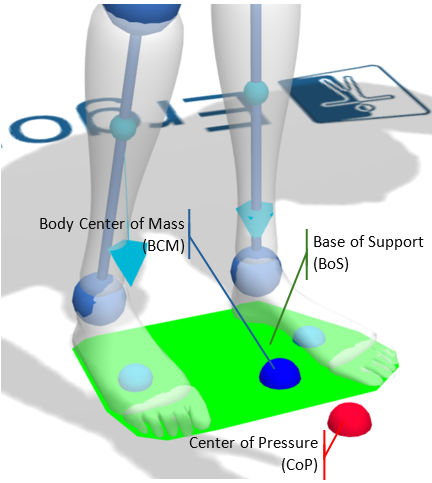
Figure 11: Location of the center of pressure on the base of support
For a posture to remain in static equilibrium, the forces and moments generated at the supports must balance those produced by the weight of the body segments, external loads or forces, and applied moments. In the model, this requires the center of pressure to remain within the base of support (BoS). The base of support is bounded by the effective contact points between the body and the floor; during normal bipedal stance, it corresponds to the area defined by the two foot supports.
In the case shown in Figure 11, the center of pressure lies outside and in front of the base of support, so the model identifies instability with possible forward tipping. The body center of mass, however, remains within the base of support. Therefore, in the absence of external loads, forces, or moments applied at the hands, the represented posture would be stable.
To display the segmental centers of gravity, body center of mass, center of pressure, and base of support, use the Stabilogram tool (Figure 30), described in Section 7.8.