Postural load
The Postural load dialog displays several indicators related to the postural demand of the assessed posture or activity. Open it with Posture in the left-side menu.
When first opened, it displays postural discomfort. You can also enable the REBA and LUBA results with the controls at the top.
The dialog provides an overview of three approaches to postural assessment: discomfort by body segment, the REBA method, and the LUBA method. Their detailed manual sections provide further information.
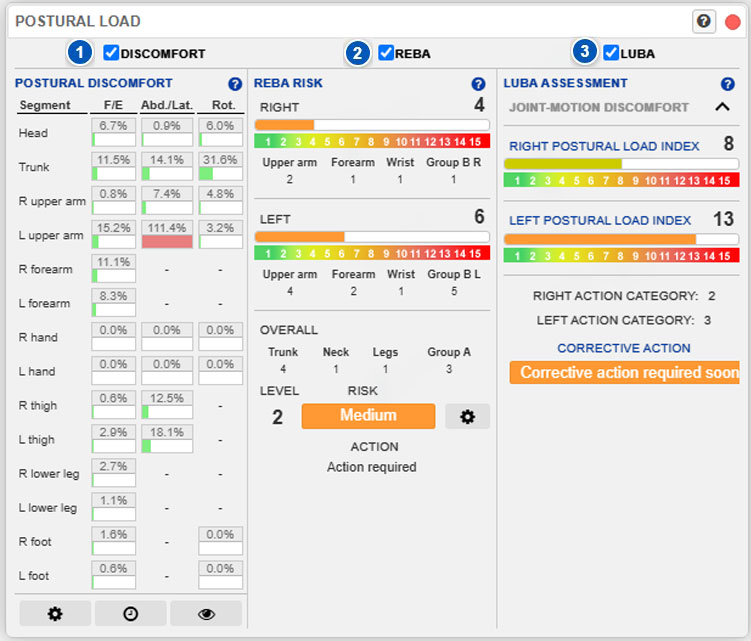
| No. | Control | Function |
|---|---|---|
| 1 | Discomfort | Displays postural discomfort associated with different body segments and movements. |
| 2 | REBA | Displays postural risk calculated using REBA. |
| 3 | LUBA | Displays postural load calculated using LUBA. |
Purpose of the dialog
Postural load reviews the model’s postural demand from several perspectives.
The same posture can produce different results under different criteria. It can, for example, show high discomfort in one segment while receiving a moderate overall level under a postural-assessment method. REBA and LUBA can also differ because they do not use exactly the same criteria or weighting.
Do not interpret the dialog as a single result. It is an integrated view of several postural indicators.
Enable visible measurements
The controls at the top are:
- Discomfort, identified by number 1;
- REBA, identified by number 2;
- LUBA, identified by number 3.
Discomfort is enabled initially. Enabling REBA or LUBA expands the dialog to display the corresponding panels.
This keeps the view compact when only discomfort is needed and provides more information when method-specific results are to be compared.
Postural discomfort
Discomfort assesses postural discomfort associated with the model’s body segments and movements.
It is based on the posture adopted by each segment and helps identify regions with the greatest demand. Values are displayed by body segment and movement in a table and visual format.
Postural discomfort is particularly useful for:
- identifying body segments in demanding postures;
- comparing design or redesign alternatives;
- locating the segment contributing most to a postural problem;
- reviewing changes after manually modifying posture;
- analyzing postures that do not necessarily fit a particular standardized method.
Unlike a global method, Discomfort provides a segmented reading rather than only one final category.
For details, see Postural load: Discomfort.
REBA assessment
REBA displays results from Rapid Entire Body Assessment, a method used to assess postural risk in tasks involving the whole body.
REBA combines the posture of different body regions with other task factors to produce a score and risk level. Categories guide the need for action.
The REBA panel displays partial results for body groups and an overall result, showing both the contribution of specific regions and the final posture assessment.
REBA is useful for:
- obtaining an overall postural-risk assessment;
- analyzing tasks involving the trunk, neck, legs, and upper limbs;
- obtaining an interpretable risk category;
- comparing the posture using a widely used ergonomic method.
REBA does not measure exactly the same thing as postural discomfort. It applies method-specific risk rules, whereas Discomfort focuses on demand or discomfort by segment and movement.
For details, see Postural load: REBA.
LUBA assessment
LUBA displays results from Loading on the Upper Body Assessment, a method focused especially on upper-body postural load.
The panel displays discomfort indices and action categories, separating the right and left sides where applicable. This is useful for asymmetric tasks.
LUBA is useful for:
- assessing upper-body postural load;
- comparing right- and left-side demand;
- obtaining a LUBA action category;
- reviewing postures substantially affecting the trunk, neck, shoulders, or upper limbs.
Although LUBA and Discomfort use related concepts, they are not equivalent. LUBA is a structured method with its own scoring and categorization rules. Discomfort provides a more detailed reading by body segment and movement within Ergoniza Intelligent.
For details, see Postural load: LUBA.
Differences among Discomfort, REBA, and LUBA
| Measurement | What it represents | Primary use |
|---|---|---|
| Discomfort | Estimated postural discomfort by body segment and movement. | Identify segments with the greatest postural demand and compare posture or design alternatives. |
| REBA | Overall postural risk under the REBA method. | Obtain an overall risk assessment and guidance on the need for action. |
| LUBA | Postural load under LUBA, focused particularly on the upper body. | Assess postural load, especially in postures affecting the trunk, neck, and upper limbs. |
Compare these measurements cautiously. They are not expected to reach the same conclusion because each uses different criteria.
For example:
- Discomfort can identify a high value in one body region even when a global method is not extreme.
- REBA can produce a high overall risk category from the combination of several regions and task factors.
- LUBA can highlight upper-body load or differences between the right and left sides.
Use the three measurements as complementary information.
General interpretation
- First review Discomfort to locate the body segments or movements with the greatest demand.
- Enable REBA for an overall method-specific assessment of postural risk.
- Enable LUBA to assess postural load, particularly in the upper body.
- Compare the results while remembering that each method uses different criteria.
- If a result is unexpected, first review the model posture, entered loads, and task conditions.
Together, the three indicators provide a more complete view of postural load than any one method alone.
Related manual sections
Relationship with the Technical foundations
For methodological details, see:
- Postural discomfort
- Measuring postural discomfort: psychophysical basis
- Display of discomfort on the model
- Details of postural-discomfort calculation for momentary or unsustained postures
- Risk assessment of adopted postures using REBA and LUBA
- Postural-risk assessment using REBA
- Risk assessment for unsuitable postures using LUBA
- Conceptual differences between single-posture and multiple-posture analysis
The Technical foundations explain the calculations and methodological differences; this manual focuses on operational use and practical interpretation.