7 SUPPORT MODELING
The reaction at the contact between the body and the floor—generally at the soles of the feet—is a force distributed over the entire contact surface. If external forces or loads have no horizontal components, the contact forces needed to balance them will likewise have no horizontal components and will be normal to the floor. In general, the distribution of the reactions depends on the position of the center of pressure relative to the base of support and on the geometry of the active supports.
Ergoniza Intelligent can account for different contact areas between the body and the floor. Specifically, it detects the soles of the feet, the front of the knees, and two points on the pelvis located approximately at the ischial tuberosities.
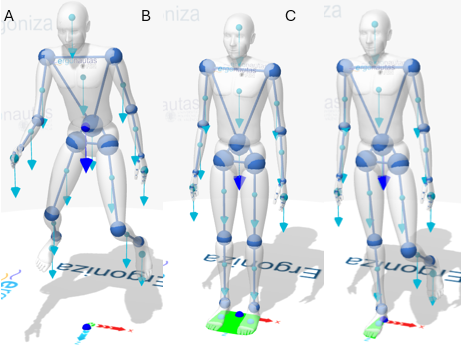
Figure 13: Type of contact between the model and the floor; A: No support, B: Bipedal stance, C: Single-leg stance
Although the actual reaction is distributed over a surface, Ergoniza Intelligent represents it by means of forces concentrated at a limited number of points. Each foot has two possible support points: the heel at the rear and the central metatarsal contact area at the front. Contacts at the knees and ischial tuberosities are also represented as points.
A linear variation in pressure is assumed when distributing the reactions among these points. In addition, the vertical components of the reactions can only act upward: a support can separate from the floor, but it cannot exert a downward tensile force. This condition represents the unilateral nature of contact and prevents negative reactions from being used to stabilize a posture whose center of pressure lies outside the base of support. It implies, for example, that the footwear is not rigidly attached to the floor and therefore cannot generate moments that counteract an unbalanced posture.
The calculation for contacts at the feet is explained first. The procedure is then adapted to knee supports in Section 7.5, pelvic supports in Section 7.6, and seated posture on a chair in Section 7.7.
Considering foot contacts first, Ergoniza Intelligent distinguishes three situations, shown in Figure 13: no support, when neither foot produces an effective reaction against the floor; bipedal stance, when both feet produce reaction forces; and single-leg stance, when only one foot does so.
Detecting physical proximity between a foot and the floor is not sufficient to determine the support condition. An effective reaction force must also exist. Therefore, if both feet are in contact with the floor but one of them supports no reaction, the model is considered to be in single-leg stance.
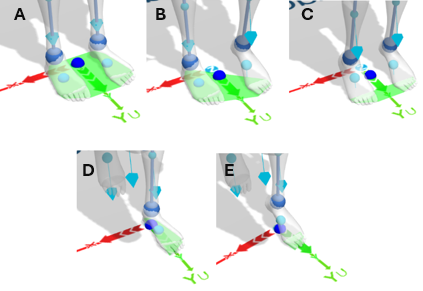
Figure 14: Different numbers of supports in bipedal and single-leg stance.
Because two possible support points are considered for each foot, bipedal stance can have between two and four active points (cases A, B, and C in Figure 14), whereas single-leg stance can have one or two (cases D and E).