Lumbar compression
The Lumbar Compression window analyzes compression and shear forces acting on the L4/L5 intervertebral disc. Open it with Back on the left menu.
This analysis is especially relevant to manual handling, pushing, pulling, inclined-trunk postures, and other tasks with substantial lumbar demands. It estimates lumbar load from posture, external loads, body weight, trunk orientation, and the muscular activity needed to maintain the posture.
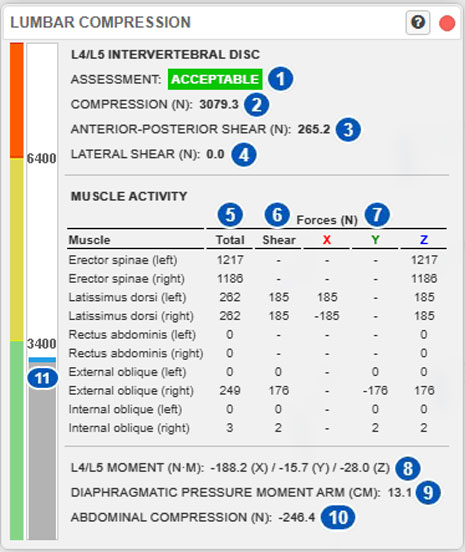
| No. | Area or control | Function |
|---|---|---|
| 1 | Diagnosis | Shows the overall lumbar-compression classification. |
| 2 | L4/L5 compression | Shows estimated axial compression on the L4/L5 disc in newtons. |
| 3 | Anterior-posterior shear | Shows estimated anterior-posterior shear on L4/L5 in newtons. |
| 4 | Lateral shear | Shows estimated lateral shear on L4/L5 in newtons. |
| 5 | Total muscular activity | Shows the total force generated by each muscle or muscle group in the lumbar model. |
| 6 | Muscular shear component | Shows the component of muscular force that contributes to shear. |
| 7 | X, Y, and Z components | Show spatial components of muscular forces in newtons. |
| 8 | L4/L5 moment | Shows the net moment at L4/L5 on the X, Y, and Z axes. |
| 9 | Diaphragmatic-pressure moment arm | Shows the intra-abdominal-pressure moment arm in centimeters. |
| 10 | Abdominal compression | Shows the force associated with the intra-abdominal pressure used by the model. |
| 11 | Compression indicator | Graphically compares lumbar compression with reference values. |
Purpose of the window
The analysis estimates three main components at L4/L5:
- axial compression;
- anterior-posterior shear;
- lateral shear.
Lumbar discs—particularly L5/S1 and L4/L5—are critical structures during lifting, load handling, and trunk flexion. Excessive forces may increase the risk of low-back pain, disc degeneration, herniation, and other back disorders.
Ergoniza Intelligent calculates at L4/L5, where available biomechanical data support modeling trunk-muscle action and internal loads.
Effect of the backrest
When the model is seated in a chair and Backrest is enabled, Ergoniza Intelligent unloads the flexion component of the torso moment before calculating lumbar results.
Lateral-flexion and rotation components remain, and the extension moment is not canceled. The system recalculates the lumbar moment, muscular activity, compression, and L4/L5 shear from the remaining components.
Enabling the backrest can therefore change compression or shear, but does not guarantee a reduction or make the results zero.
The backrest is not modeled as an external force or support reaction and has no effect unless the model is identified as seated in a chair. See Model settings and Seated posture.
Diagnosis
Indicator 1 summarizes the result from the calculated compression and shear. In the figure, Acceptable means that the posture and loads produce values below the applicable reference limits.
Treat the diagnosis as a summary. Also review:
- compression;
- shear forces;
- trunk posture;
- applied loads;
- calculated muscular activity;
- reference limits for the selected age and sex.
L4/L5 compression
Value 2 is the estimated axial compression force on L4/L5 in newtons (N).
Axial compression acts approximately perpendicular to the disc plane. It depends not only on the external load, but also on:
- the weight of body segments above the disc;
- trunk posture;
- the load’s distance from the spine;
- intervertebral-disc orientation;
- trunk-muscle contraction;
- intra-abdominal pressure;
- loads on the hands or other body segments.
During lifting or sustained trunk flexion, trunk muscles generate forces to balance external moments. This necessary activity may increase disc compression.
Compression reference values
NIOSH established 3,400 N as a classic lumbar-compression Action Limit. Above this value, the risk of low-back disorders increases and improvement measures should be considered.
A classic Maximum Permissible Limit of 6,400 N has also been used for high-risk situations. It is a critical threshold that should not be exceeded, not an acceptable target.
Ergoniza Intelligent uses these as general references but may adjust limits from model parameters, particularly:
- sex;
- age;
- anthropometric characteristics;
- human-model configuration.
Spinal structural strength can vary with age and sex, and aging can reduce mechanical resistance. More conservative limits may therefore apply to some populations.
Anterior-posterior shear
Value 3 is the anterior-posterior shear on L4/L5 in newtons (N).
This tangential component acts in the anterior-posterior direction and tends to produce relative displacement between vertebral structures. It may increase with:
- trunk flexion;
- loads held far from the body;
- asymmetric postures;
- pronounced inclination;
- external forces with a horizontal component;
- combined flexion and manual load.
Ergoniza Intelligent uses a 500 N shear reference limit. Exceeding it may indicate increased risk of tissue damage, segmental instability, or lumbar injury.
Lateral shear
Value 4 is the lateral shear on L4/L5 in newtons (N).
It is particularly relevant to asymmetric postures, trunk rotation or lateral flexion, and loads displaced to one side. It may be low in symmetric postures but important during twisting, side bending, or unilateral loading.
Interpret it together with:
- trunk rotation and lateral flexion;
- external-load positions;
- weight distribution among supports;
- the stabilogram.
See Postural information and Stabilogram.
Muscular activity
Areas 5, 6, and 7 show the muscular activity used to balance posture and external loads.
The model contains ten abdominal and lumbar muscles or groups in five left-right pairs:
- left and right Erector Spinae;
- left and right Latissimus dorsi;
- left and right Rectus abdominis;
- left and right Obliquus externus;
- left and right Obliquus internus.
The system estimates the forces required to satisfy equilibrium conditions.
Total muscular force
Column 5 shows the total contraction force of each modeled muscle or group in newtons (N).
High force may indicate substantial activation to maintain posture or counter external loads. Do not interpret it alone: its effect on the disc also depends on the muscle line of action and its compression or shear contribution.
Muscular shear component
Column 6 shows the muscular-force component contributing to shear.
It helps identify which muscles contribute most to tangential forces. Depending on spatial orientation, muscular forces can produce both axial compression and shear, explaining high shear even when the external load appears moderate.
X, Y, and Z muscular-force components
Columns 7 show the X, Y, and Z components in newtons (N).
They resolve each muscle force along the model’s reference axes. Interpretation depends on trunk orientation and disc plane. In general, components contribute to compression, anterior-posterior shear, or lateral shear.
This decomposition is necessary because L4/L5 orientation changes with the trunk, legs, and pelvis.
L4/L5 moment
Value 8 shows the net L4/L5 moment in N·m, resolved into X, Y, and Z components.
It is the rotational tendency that must be balanced at L4/L5 and may be caused by:
- trunk weight;
- head and upper-limb weight;
- supported loads;
- trunk posture;
- abdominal and lumbar muscles;
- intra-abdominal pressure.
The model seeks muscular forces and intra-abdominal pressure that balance acting forces and moments while estimating resulting disc compression and shear.
Intra-abdominal and diaphragmatic pressure
Value 9 shows the diaphragmatic-pressure moment arm in centimeters.
Intra-abdominal pressure is generated by coordinated action of the diaphragm, abdominal wall and muscles, and pelvic floor. During physical exertion it can internally support and stabilize the spine and resist part of the moment caused by external loads and trunk weight.
The associated force does not act on the spinal axis itself. Its effective distance from the disc is the displayed moment arm, which allows the force to create a stabilizing moment.
Abdominal compression
Value 10 shows abdominal compression in newtons (N), representing the force associated with the modeled intra-abdominal pressure. Its sign follows the calculation convention and must be interpreted within overall equilibrium.
Intra-abdominal pressure can both:
- stabilize the spine and reduce part of the net compression borne directly by the disc;
- be associated with greater muscular activation, which may increase compression.
Interpret it with muscular activity, the L4/L5 moment, and final calculated compression.
Graphic compression indicator
Indicator 11 compares calculated L4/L5 compression with classic reference limits:
- 3,400 N: NIOSH Action Limit; above it, risk increases and task review or redesign is recommended.
- 6,400 N: classic Maximum Permissible Limit; exceeding it is associated with high risk and should be avoided.
Ergoniza Intelligent may adjust these limits for age, sex, and other model parameters. The diagnosis therefore uses criteria applicable to the current model, not only the standard values.
How lumbar compression is calculated
The three-dimensional equilibrium model considers:
- body-segment weight above L4/L5;
- loads held in the hands;
- loads on other body segments;
- intra-abdominal pressure;
- trunk-muscle contraction forces;
- spatial orientation of L4/L5;
- the moment generated by all these forces.
More muscles act than there are equilibrium equations, so optimization is used to obtain a solution compatible with posture, loads, and muscular capacities.
In simplified terms, the model seeks a muscular distribution that:
- balances the posture;
- limits relative muscular activation;
- minimizes resulting disc compression while satisfying equilibrium.
Relationship to external loads
Loads held far from the body can greatly increase the lumbar flexion moment, muscular activation, and disc compression. Lateral or asymmetric loads may increase shear.
Verify the loads under:
Incorrect load magnitude or direction can make the result unrepresentative.
Relationship to model posture
Trunk, pelvis, and leg posture directly affect the L4/L5 moment, disc orientation, muscular contribution, axial compression, and shear.
Trunk flexion, lateral flexion, rotation, or combinations of these movements can all change the result. Review Postural information, Seated posture, and Stabilogram.
Practical interpretation
- Review the overall diagnosis.
- Check L4/L5 compression.
- Compare it with the graphic indicator and reference limits.
- Review anterior-posterior and lateral shear.
- Examine muscular activity when values are high.
- Check the L4/L5 moment.
- Review the role of intra-abdominal pressure.
- Verify posture, load, and supports.
- If the result is high, consider reducing the load, moving it closer to the body, improving posture, or modifying the task.
Recommendations for use
Use this window particularly for:
- load lifting and carrying;
- pushing or pulling;
- sustained trunk flexion;
- lumbar rotation;
- asymmetric postures;
- loads far from the body;
- handling heavy objects.
Do not interpret lumbar compression alone. Consider it with model posture, applied loads, biomechanical exertion, stability, and task duration and repetitiveness.
Related User Manual sections
- Exertion
- Biomechanical exertions
- Joint loads
- Load or force on the hands
- Loads on body segments
- Postural information
- Seated posture
- Stabilogram
Relationship to the Technical foundations
For further methodological detail, see:
- Risk analysis for lumbar-spine compression and shear
- Calculating compression and shear at L4/L5
- Force associated with intra-abdominal pressure
- Iterative model for trunk-muscle forces
- Joint-load calculation
- Limitations in calculating biomechanical moments and exertions
These sections explain lumbar compression, intra-abdominal pressure, the trunk-muscle model, reference limits, and methodological limitations.