Postural load: REBA
The REBA assessment panel is part of the Postural load dialog and displays postural-risk results obtained with REBA.
REBA, Rapid Entire Body Assessment, is an observational method for assessing risk from postures adopted during work. It considers the trunk, neck, legs, upper arms, forearms, and wrists, as well as task factors that can modify the final score.
In Ergoniza Intelligent, postural scores are calculated from the model posture. The panel displays partial and overall method results.
For an overview of the complete dialog, see Postural load.
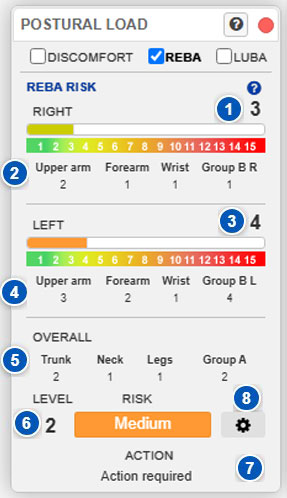
| No. | Area or control | Function |
|---|---|---|
| 1 | Right-side REBA assessment | Displays the REBA result obtained with Group B for the right side. |
| 2 | Right Group B scores | Displays the right upper-arm, forearm, wrist, and Group B scores. |
| 3 | Left-side REBA assessment | Displays the REBA result obtained with Group B for the left side. |
| 4 | Left Group B scores | Displays the left upper-arm, forearm, wrist, and Group B scores. |
| 5 | Group A scores | Displays the trunk, neck, legs, and Group A scores. |
| 6 | REBA level and risk | Displays the action level and resulting risk category. |
| 7 | Corrective action | Indicates the need for intervention according to the REBA risk level. |
| 8 | REBA options | Opens the method-specific REBA options. |
Purpose of the REBA panel
The REBA assessment panel provides a structured assessment of postural risk for the evaluated posture.
Unlike Discomfort, which displays percentages by body segment and movement, REBA provides a method-specific score based on defined rules. The result comprises partial scores, an overall score, a risk level, and a recommended action.
REBA is particularly useful for:
- obtaining an overall postural-risk assessment;
- analyzing whole-body tasks;
- identifying contributions from different body regions;
- obtaining an interpretable risk category;
- guiding the need for corrective action.
Always interpret the result in light of posture, loads, repetitiveness, supports, and the specific task conditions configured for the analysis.
Right-side REBA assessment
Area 1 displays the REBA score for the right side.
In REBA, Group B is assessed separately for the right and left sides because upper-limb postures can be asymmetric. The panel therefore provides a specific right-side result.
It summarizes right Group B and helps identify whether the right side makes a relevant contribution to postural risk.
Right Group B scores
Area 2 displays the partial right Group B scores:
- right upper arm;
- right forearm;
- right wrist;
- combined right Group B score.
These scores identify which upper-limb segment contributes most to the right-side result. When the overall right-side value is high, review the partial scores to determine whether the main contribution comes from the upper arm, forearm, or wrist.
Left-side REBA assessment
Area 3 displays the REBA score for the left side.
Left Group B is calculated separately, allowing asymmetric tasks to be assessed when one upper limb adopts a less favorable posture than the other.
Comparing the right- and left-side results helps identify postural imbalances between the two sides.
Left Group B scores
Area 4 displays the partial left Group B scores:
- left upper arm;
- left forearm;
- left wrist;
- combined left Group B score.
These values help explain the left-side result and locate the upper-limb segment making the largest contribution.
For tasks in which one hand holds a load while the other guides, pushes, or supports, the two sides can differ substantially.
Group A scores
Area 5 displays Group A scores:
- trunk;
- neck;
- legs;
- combined Group A score.
These scores are common to the overall body assessment and represent contributions from the central and lower body regions.
Group A is particularly relevant when there is:
- trunk flexion or twisting;
- neck inclination;
- unstable or asymmetric leg support;
- awkward whole-body posture.
If Group A is high, review the overall posture before focusing exclusively on the upper limbs.
Level, risk, and action
Area 6 displays the REBA level and risk category.
The level summarizes posture severity under the method’s rules. The risk category provides a qualitative interpretation, such as low, medium, high, or very high, depending on the score.
Area 7 displays the corrective action, which guides the need for intervention based on the REBA result.
Treat this action as ergonomic guidance, not an isolated automatic decision. Before deciding on an intervention, verify:
- that the assessed posture represents the actual task;
- that the entered load is correct;
- that the REBA options are appropriate;
- whether the posture is momentary, sustained, or repetitive;
- whether supports or task conditions must be configured.
REBA options
Button 8 opens the REBA options.
They define additional conditions that can affect the assessment, including sustained posture, repetitiveness, significant postural changes, sudden impacts or loads, coupling quality, sustained load, and upper-arm support or favorable orientation relative to gravity.
For details, see REBA: analysis settings.
After changing REBA options, review the panel again because the final score, risk category, and corrective action can change.
Differences from Discomfort and LUBA
REBA is a specific method-based assessment and does not measure exactly the same thing as Discomfort or LUBA.
- Discomfort displays percentages by body segment and movement.
- REBA provides a score and risk category under the REBA rules.
- LUBA assesses postural load with another method focused especially on the upper body.
The three panels can therefore produce nonequivalent results without being contradictory; each uses a different approach.
See also:
Interpretation recommendations
- First verify that the model posture represents the task.
- Check Group A scores.
- Review right and left Group B scores.
- Determine whether risk is symmetric or one side contributes more.
- Review the level, risk category, and corrective action.
- Open the REBA options if additional factors must be configured.
- If the result appears inconsistent, recheck posture, loads, and analysis conditions.
A poorly captured posture or incomplete configuration can produce an unrepresentative REBA result.
Relationship with the Technical foundations
For a fuller methodological explanation, see:
- Risk assessment of adopted postures using REBA and LUBA
- Postural-risk assessment using REBA
- Risk assessment for unsuitable postures using LUBA
- Conceptual differences between single-posture and multiple-posture analysis
These sections explain REBA’s methodological basis, its relationship with other postural methods, and limits on interpreting its results.