Biomechanical exertions
The Exertions panel is part of Exertion. For each joint and degree of freedom, it shows the moment required by the posture, the functional muscle group that must act, estimated population capacity, and the reference moment for the case.
By default, the table shows the limit used to calculate Percentage of Maximum Recommended Exertion (%MRE). If Calculate max. recommended exertion (%) is disabled, Reference moment shows either recommended joint capacity or estimated maximum isometric capacity, depending on the mode and settings.
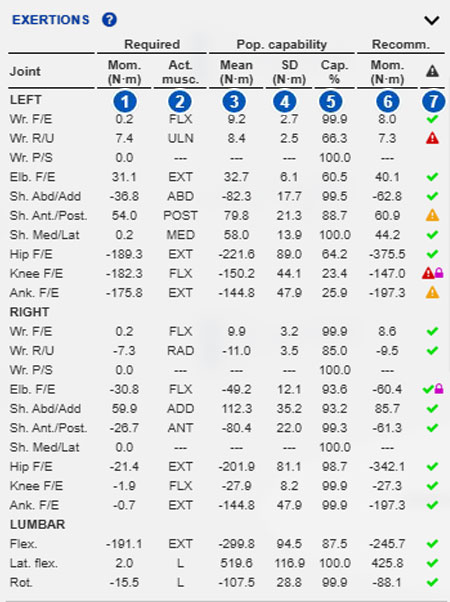
The figure shows default %MRE behavior. The table structure does not change for another indicator, although reference moments and status symbols may change.
Columns 6 and 7 below describe the exertion/capacity view. When Unprotected Population is selected, they instead show the population level and classification described in Unprotected population.
| No. | Column | Function |
|---|---|---|
| 1 | Required moment | Joint moment required to maintain the posture with applied loads, in N·m. |
| 2 | Acting muscle | Functional muscle group that must balance the required moment. |
| 3 | Mean population capacity | Estimated mean maximum isometric capacity for that joint and movement, in N·m. |
| 4 | Population-capacity standard deviation | Estimated dispersion of population capacity, in N·m. |
| 5 | Protected population percentage | Percentage of the reference population that could perform the exertion without exceeding the capacity criterion. |
| 6 | Reference moment | Capacity or limit used to compare the required moment: the %MRE limit, recommended joint capacity, or estimated maximum isometric capacity. |
| 7 | Status indicator | Classifies the active percentage using visual thresholds and also warns about certain joint-limit conditions. |
Purpose of the panel
Each row combines a joint or body segment, movement, required moment, acting functional group, population capacity, protected percentage, reference moment, and status.
Use it with:
- Exertion and joint-capacity indicators
- Unprotected population
- Cumulative exertion load
- Joint loads
- Support reaction loads
Organization
The table is divided into left, right, and lumbar sections. It covers wrist flexion/extension, lateral deviation and rotation; elbow flexion; shoulder abduction/adduction, anterior/posterior motion and rotation; hip, knee and ankle flexion/extension; and lumbar flexion, lateral flexion, and rotation.
Labels are abbreviated to keep the table compact.
Required moment
Column 1 shows the required moment in N·m.
It is the joint moment that must be balanced to maintain the posture with the applied loads. It depends on posture, body-segment weights, loads and forces on the hands or other segments, support distribution, seated condition, and segment positions.
The moment sign follows the angular convention. Interpret it with Acting muscle, which identifies the functional group that must act, rather than treating positive or negative signs alone as favorable or unfavorable.
See Postural information.
Acting muscle
Column 2 identifies the acting functional muscle group, not necessarily one isolated anatomical muscle.
Typical abbreviations are:
| Abbreviation | Meaning |
|---|---|
| FLX | Flexors or flexion group. |
| EXT | Extensors or extension group. |
| RAD | Radial-deviation group. |
| ULN | Ulnar-deviation group. |
| ABD | Abduction group. |
| ADD | Adduction group. |
| ANT | Anterior-action group. |
| POST | Posterior-action group. |
| MED | Medial-rotation group. |
| LAT | Lateral-rotation group. |
| L | Leftward action or rotation. |
| R | Rightward action or rotation. |
| — | No specific group is shown because there is no interpretable exertion. |
Interpret abbreviations with the assessed joint and required moment.
Population capacity
Pop. capability shows the statistical distribution of the reference population’s estimated ability to generate or resist the exertion. It does not describe one person’s capacity.
It includes mean, standard deviation, and protected-population percentage.
Mean population capacity
Column 3, Mean, is the estimated mean maximum isometric capacity for the joint and degree of freedom in N·m.
It depends on the joint, posture of adjacent joints, degree of freedom, functional group, and reference population.
Population-capacity standard deviation
Column 4, SD, shows capacity dispersion in N·m. A larger value represents greater estimated variability among individuals.
Mean and standard deviation are used together to estimate the protected and unprotected population proportions.
Protected population percentage
Column 5, Cap. %, estimates the proportion of the reference population that could perform the required exertion without exceeding the capacity criterion.
A value near 100% means nearly all of the reference population would be protected. A low value means the exertion is within the capacity of only a small proportion.
The complementary perspective appears under Unprotected population.
Reference moment
Column 6 shows the reference moment in N·m:
- with %MRE, the preventive-priority limit including body-region weighting;
- for a single posture without %MRE, recommended joint capacity for the configured duration and repetition;
- in Multiple Postures mode with previous exertion included, the recommended capacity available at that instant, which can decrease during exertion and recover during rest;
- otherwise, estimated maximum isometric capacity without previous exertion or rest.
Changing the indicator does not change required moment, population mean, standard deviation, or protected percentage; it changes the personalized reference.
Reference moment depends on sex, age, body build, anthropometry, dominant side, joint, movement, duration, repetition, and—when applicable—previous exertion and recovery. For %MRE it also depends on Influence and the body region.
See Model settings and Biomechanical analysis settings.
Status indicator
Column 7 compares required and reference moments using the Warning and Risk thresholds under Visualization settings, initially 85% and 100%. Threshold changes alter visual classification, not calculated biomechanics.
Green check mark
Below the Warning threshold; initially below 85%.
Orange exclamation mark
At or above Warning but below Risk; initially 85% to less than 100%. Review sustained, repeated, or additionally loaded conditions.
Red exclamation mark
At or above Risk; initially 100% or more, meaning that required moment has reached or exceeded the reference moment. Give these results priority.
Purple lock
The purple lock means that the joint is at the end of its range of motion. It is independent of the percentage classification and can appear with another status symbol.
At a motion limit, passive structures may contribute to resisting the external moment because active muscular force alone may not balance it. This is not a safe-state indication. It may involve reduced active force capacity, increased passive-structure load, sensitivity to small posture/load errors, and greater potential for discomfort or injury.
Red horizontal-bar symbol
This symbol means that the reference moment is zero because exertion in that movement and direction is not recommended, for example when the external moment tends to move an extreme joint farther beyond its range.
It is a joint-limit warning, not a conventional exertion percentage.
Required moment versus reference moment
The active percentage is the relationship between column 1 Required moment and column 6 Reference moment. Column 7 classifies that percentage.
This numerical detail explains the chart in Exertion and joint-capacity indicators.
Relationship to posture and loads
Required moments are directly affected by posture and applied loads. Segments far from the body, elevated arms, trunk inclination, or held loads can increase joint moments.
Review:
Duration and repetitiveness
Required moment describes the posture’s mechanical demand and normally does not change with duration or repetition, but its reference capacity or limit can.
For a single posture, Action duration and repetitiveness determines the recommended proportion of maximum capacity.
In Multiple Postures mode, Activity repetitions defines order, duration, repetitions, and rest. When previous exertion is included, recommended capacity is updated throughout the activity.
This update is separate from Cumulative exertion load, although both use the same time sequence. A posture below thresholds in isolation may exceed them after sustained or repeated activity.
Interpretation procedure
- Read the upper panel title to identify the active percentage.
- Identify the capacity or limit in Reference moment.
- Review Warning and Risk thresholds.
- Locate red and then orange rows.
- Check for purple locks or red horizontal-bar symbols.
- Identify the affected joint, side, and movement.
- Compare required and reference moments.
- Identify the acting functional group.
- Review posture, loads, and supports.
- In Multiple Postures mode, check repetitions, rest, and whether previous exertion affects recommended capacity.
- Review exertion, cumulative load, and unprotected-population panels together.
Do not interpret one row in isolation. Consider the complete posture, load, duration, and supports. Keep settings constant when comparing alternatives, and do not treat %MRE as individual injury probability.
Related User Manual sections
- Exertion
- Exertion and joint-capacity indicators
- Cumulative exertion load
- Joint loads
- Support reaction loads
- Biomechanical analysis settings
Relationship to the Technical foundations
For further methodological detail, see:
- Overexertion risk analysis
- Maximum joint capacities
- Exertion assessment
- Personalized exertion assessment
- Percentage of Maximum Recommended Exertion
- Interface representation
- Joint-limit conditions at the elbow and knee
- Instantaneous relative exertion
- 3CC-r model and Recommended Moment
- Separation by joint, biomechanical channel, and functional muscle group
- Recommended maximum voluntary contraction percentage in single-posture analysis
- Limitations of joint exertion as the sole risk indicator
- Limitations in calculating biomechanical moments and exertions
These sections explain joint moments, exertion and capacity indicators, population interpretation, recommended-capacity updates, joint-limit conditions, and methodological limitations.