7.3 Partial slipping
As shown in Section 6.1, when sustained loads or forces include horizontal components, maintaining the posture requires them to be balanced by the friction forces between the footwear—or another type of support—and the floor. The available friction force must be equal to or greater than the resultant of the horizontal components of the external loads or forces. Otherwise, the model will slip and the posture cannot be maintained.
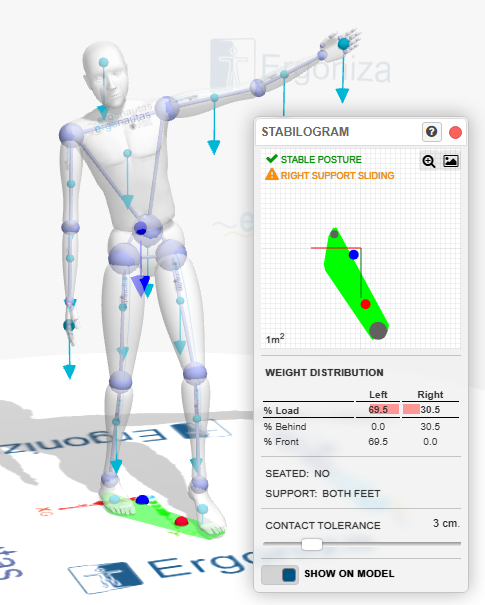
Figure 23: Partial slipping.
After the distribution of the reaction forces in bipedal stance has been calculated, the horizontal resultant assigned to one foot may exceed the maximum friction force available at that support, even though the combined friction capacity of both supports is sufficient to maintain the posture.
Ergoniza Intelligent checks for this situation by calculating the maximum friction force available at each support from the vertical reaction components and the coefficient of friction with the floor, using Equation 1 presented in Section 6.1.
When one support exceeds its friction limit, Ergoniza Intelligent transfers to the other support the portion of the horizontal reaction that it can assume without exceeding its own friction capacity. This correction changes the distribution of the horizontal components between the feet, but not the previously calculated vertical distribution. If the transfer satisfies the global criterion, the Stabilogram (Figure 23) displays a partial-slipping warning that identifies the support initially affected, although the posture can be maintained after redistribution.
If the slipping problem at one support cannot be compensated for by redistributing the loads, a global-slipping warning is displayed, indicating that the posture cannot be maintained.