7.5 Knee supports
Ergoniza Intelligent detects whether one or both knees are supported on the floor. When this occurs, the method used to calculate the reactions at the supports is modified to account for the new contact points.
Figure 26 shows a posture in which the model is supported on both knees and both feet. In this situation, reactions occur at the knees and at one contact area on each foot. Their distribution is calculated in a manner similar to that described above, except that the knees act as the front supports and the foot contact areas as the rear supports, as shown in Figure 27. However, the presence of knee supports changes the calculation of the joint loads at the ankles and knees, as explained in Section 8.2.2.3.
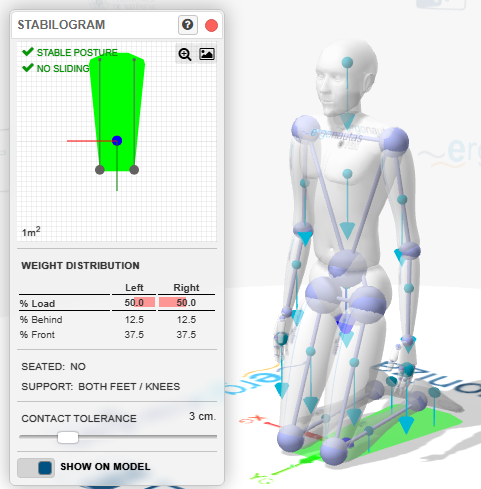
Figure 26: Model supported on the knees and both feet.
Several considerations must be taken into account when knee support occurs. The coefficient of friction used to calculate possible slipping at these supports is the same as that defined for the contact between the sole of the footwear and the floor. In addition, only two support areas can exist on each side of the body. Therefore, if the knee and foot of the same leg are in contact with the floor, the knee and only one area of the foot are considered. When both the forefoot and heel are supported, the program retains the forefoot as the support area; if only the heel is supported, it uses the heel. This simplification generally does not represent a significant limitation, because a posture involving simultaneous contact of the knee, forefoot, and heel on the same side would be extremely forced.
When a knee is supported on the floor, the reaction force exerted by the floor at the contact point must not be confused with the internal reaction at the knee joint. In the situation shown in Figure 27, Cᵣ and Cₚ identify the knee and foot contacts, while RCR and RCP represent the corresponding reaction forces at those supports. RR, in turn, represents the reaction transmitted through the knee joint. Although the knee-floor contact point and the joint center are very close, they correspond to different mechanical elements and their forces can differ considerably.
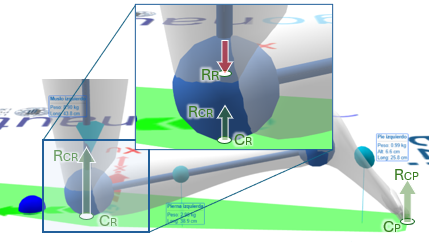
Figure 27: Reactions at the supports when knee contact exists
Accounting for knee supports can give rise to other situations, such as both feet and only one knee being supported, as shown in Figure 28, or both knees and only one foot being supported.
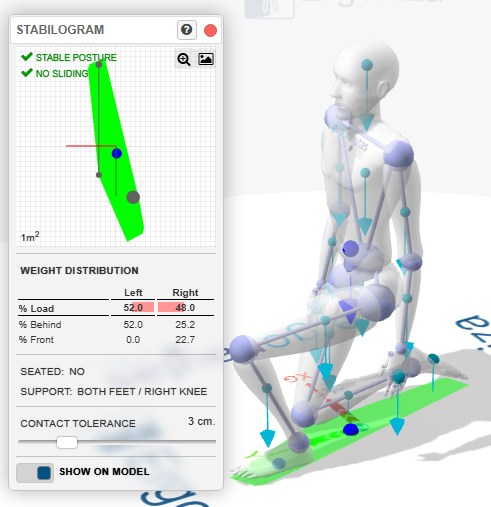
Figure 28: Model supported on one knee and both feet.