14.5 Loads and conditions that vary throughout a posture sequence
In Multiple Postures mode, the temporal sequence represents not only changes in the model's posture but also variations in certain analysis conditions over time. One of the most important of these is the external load applied during the activity.
Ergoniza Intelligent allows a load to be defined for a specific posture or a time interval in the sequence. This can be done by selecting part of the posture sequence on the timeline, right-clicking, and choosing Define load, or by pressing the Load button in the left sidebar.
This opens the dialog box shown in Figure 75, where the load, force, or moment at the hands can be defined for the selected portion of the posture sequence. The analysis is therefore not limited to a single constant load throughout the animation; it can represent situations in which the applied or handled load changes over the course of the task.
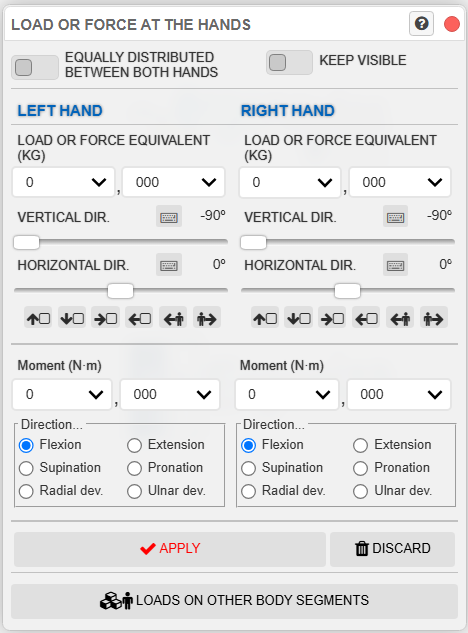
Figure 75: Load or force at the hands dialog box.
This feature is especially useful when an activity includes phases with different conditions. For example, the first part of the sequence may involve no load, followed by a phase in which an object is handled, and a final phase in which the load is no longer present. The magnitude or manner in which the load is applied may also vary at different points in the activity. In these cases, the system can explicitly represent this variability.
When a load is applied to a posture or interval, that information becomes part of the analysis conditions for that time segment. The biomechanical and ergonomic results obtained for the sequence therefore depend not only on the adopted posture but also on the load defined at each point. This is particularly relevant when calculating biomechanical exertion, cumulative exertion load, lumbar compression, and other analyses sensitive to applied external forces.
In addition to the load, some specific analysis settings can be changed throughout the sequence according to the nature of the task. For example, certain methods may require particular posture or activity conditions to be adjusted for a specific time segment. The ability to apply settings to an interval makes it possible to adapt the sequence more accurately to the observed real-world situation.