10.3.1 Concept of cumulative exertion load
A task may involve moderate instantaneous exertions yet generate relevant biomechanical exposure if those exertions are sustained for a prolonged period, repeated frequently, or repeatedly engage the same functional muscle group. Conversely, a high but very brief exertion may have a different significance than a similar exertion that is sustained or repeated without sufficient recovery periods.
For this reason, Ergoniza Intelligent incorporates the concept of cumulative exertion load in multiple-posture analysis (Figure 43). This quantity represents the temporal biomechanical exposure resulting from the history of relative exertions produced during the activity. Its calculation is not intended merely to identify the most unfavorable instant in the sequence, but to assess how the combination of intensity, duration, repetition, and partial recovery determines the cumulative demand on the joints and functional muscle groups involved.
The starting point for the calculation is the relative exertion required at each instant in the sequence. This is obtained by relating the joint moment needed to maintain the posture and balance external loads to the individualized maximum isometric capacity corresponding to the biomechanical channel and active functional muscle group. Expressing exertion in this form makes it possible to compare demands of different magnitudes relative to the functional capacity estimated for each channel and posture. However, instantaneous relative exertion is not itself the result of the cumulative analysis; it is the input variable from which the temporal exertion dose is calculated.
The transformation of relative exertion into a temporal dose is based on the nonlinear relationship between the relative intensity of a contraction and the time for which it can be maintained before fatigue is reached. This relationship has been described using Maximum Endurance Time (MET) models, including the joint-region-specific models developed by Frey Law and Avin23F1. These models show that, as relative exertion increases, the time for which the contraction can be maintained decreases sharply.
Under this approach, each interval in the sequence is interpreted as consuming a fraction of the time limit corresponding to the observed exertion level. The procedure therefore does not directly add joint moments or maximum voluntary contraction percentages, but rather temporal exposure doses. A given interval makes a greater contribution when relative exertion is high and a smaller contribution when it is low. The resulting quantity can therefore be understood as a cumulative biomechanical dose associated with exertion.
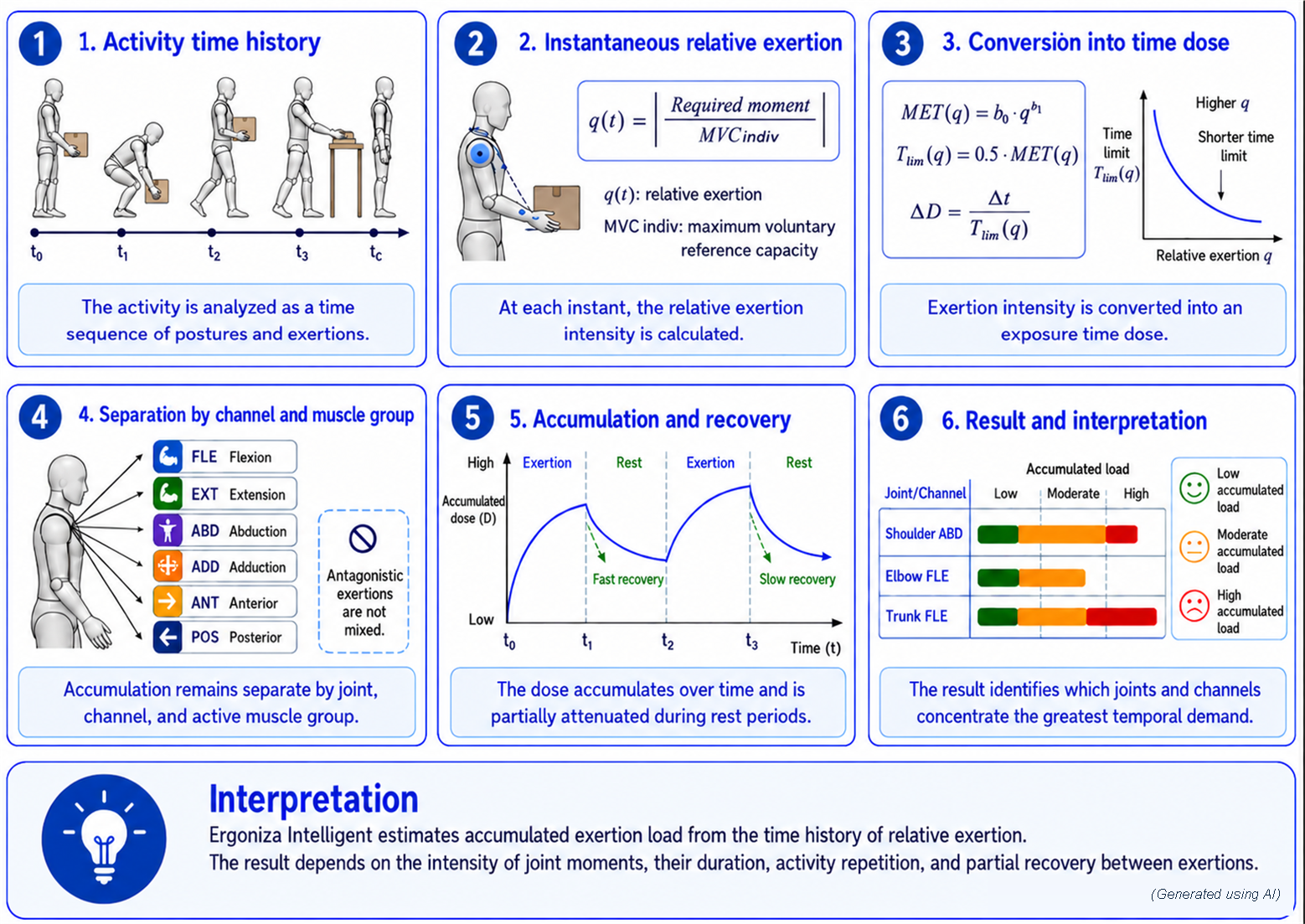
Figure 43: Calculation of cumulative exertion load in multiple postures
Accumulation is performed separately for each joint, biomechanical channel, and functional muscle group. In this context, a muscle group represents the functional group that must act to resist the calculated moment (for example, flexors, extensors, abductors, or adductors), not an individual anatomical muscle. Exertions corresponding to antagonist groups are kept separate because they do not represent the same muscular exposure. Thus, a moment requiring flexor action is not accumulated together with another that engages the extensors, and the same approach is used for the remaining exertion directions.
The procedure also recognizes that previous exposure does not retain the same relevance indefinitely. When the demand on a muscle group decreases or ceases, partial recovery may occur. This recovery is progressive and depends on the time elapsed under reduced demand or at rest. The treatment of this phenomenon is based on the dynamic fatigue and recovery models proposed by Ma et al.24F2 and by Xia and Frey Law25F3, as well as later developments by Frey Law et al.26F4, Looft et al.27F5, and Sonne and Potvin28F6 for sustained exertions, intermittent tasks, and complex force-time histories.
Cumulative exertion load should be interpreted as an ergonomic indicator of temporal biomechanical exposure. Its purpose is to help identify which joints and muscle groups concentrate the greatest demand over the course of an activity, assess the effect of repetition, estimate the influence of rest periods, and compare alternative task designs or performance methods. It is not equivalent to the instantaneous maximum voluntary contraction percentage, an average of exertions, or a direct prediction of injury or individual physiological fatigue. Its value lies in providing a structured measure of how relative muscular demand is distributed and accumulated during a posture sequence, within the biomechanical and ergonomic assumptions adopted for the analysis29F7.
Ibid.↩︎
Liang Ma et al., “A New Simple Dynamic Muscle Fatigue Model and Its Validation,” International Journal of Industrial Ergonomics 39 (2009): 211–20, doi:10.1016/j.ergon.2008.04.004.↩︎
Xia and Frey Law, “A Theoretical Approach for Modeling Peripheral Muscle Fatigue and Recovery.”↩︎
Laura A. Frey-Law, John M. Looft, and Jesse Heitsman, “A Three-Compartment Muscle Fatigue Model Accurately Predicts Joint-Specific Maximum Endurance Times for Sustained Isometric Tasks,” Journal of Biomechanics 45 (2012): 1803–8, doi:10.1016/j.jbiomech.2012.04.018.↩︎
Looft, Herkert, and Frey-Law, “Modification of a Three-Compartment Muscle Fatigue Model to Predict Peak Torque Decline during Intermittent Tasks.”↩︎
Michael W. Sonne and Jim R. Potvin, “A Modified Version of the Three-Compartment Model to Predict Fatigue during Submaximal Tasks with Complex Force-Time Histories,” Ergonomics 59, no. 1 (2016): 85–98, doi:10.1080/00140139.2015.1051597.↩︎
H. Iridiastadi and M. A. Nussbaum, “Muscle Fatigue and Endurance during Repetitive Intermittent Static Efforts: Development of Prediction Models,” Ergonomics, 2006, doi:10.1080/00140130500475666.↩︎