7.1.2 Calculation of the horizontal components of the reaction forces at the foot supports during bipedal stance
Reaction forces have horizontal components when the applied external forces also have them. To satisfy static equilibrium, the sum of the horizontal reaction components must be equal and opposite to the horizontal resultant of the external forces. In addition, the moment that these forces produce about the Z axis passing through the center of pressure must be balanced by the moment generated by the reactions.

Figure 20: Distribution of horizontal reactions for X components of external loads.
These conditions alone do not determine a unique distribution between the feet, heels, and metatarsal areas. Ergoniza Intelligent therefore analyzes the components corresponding to the X and Y axes separately and introduces additional criteria related to the relative positions of the feet.
The following expressions and diagrams correspond to the case in which all four support points are active. If a foot remains in contact only at the heel or at the front, the components corresponding to that foot are concentrated at that single point.
Figure 20 shows the case in which the external forces have a component Cx. This component generates a moment Mz about the center of pressure, which must be balanced by the reaction components Tdx, Pdx, Tix, and Pix.
When the ankles have the same Y coordinate, the total reaction in X is distributed between both feet in proportion to the vertical reaction supported by each one. For example, if the right foot supports 70% of the total vertical reaction, the magnitudes satisfy:
\[\left| T_{d,x} + P_{d,x} \right| = 0,7\left| C_{x} \right|\]
\[\left| T_{i,x} + P_{i,x} \right| = 0,3\left| C_{x} \right|\]
These reactions act in the direction opposite to Cx. Within each foot, the reaction is distributed between the heel and the front so that the moment about the ankle is zero. The Y components form a pair of opposite reactions between both feet and are distributed equally between their support points:
\[T_{i,y} = P_{i,y} = - T_{d,y} = - P_{d,y}\]
When the ankles do not have the same Y coordinate—that is, when one foot is positioned in front of the other—the distribution is adjusted according to the longitudinal separation between the feet. As this separation increases, a larger portion of the moment about the Z axis is balanced by the X components, while the portion balanced by the pair of Y components decreases.
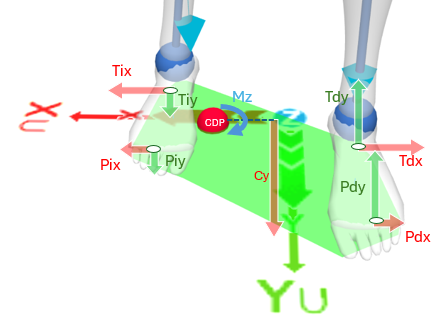
Figure 21: Distribution of horizontal reactions for Y components of external loads.
The case of an external force Cy with a Y component is shown in Figure 21. In this situation, the sum of the Y components of the reactions is equal and opposite to Cy. The X components have a zero resultant and form opposite reactions between both feet:
\[T_{i,x} + P_{i,x} = - (T_{d,x} + P_{d,x})\]
Within each foot, the components are distributed between the heel and the front so that the moment about the ankle is zero. The magnitude of the couple formed by the X components depends on the separation of the feet along the Y axis. When both ankles have the same Y coordinate, these components are zero; their magnitude increases as the longitudinal separation between the feet increases.