


Ergonomics Check Point
Containers adapted to each type of waste should be commissioned or built: open box type, cylindrical containers, or buckets for waste and garbage (of the appropriate size for the waste); closed containers for liquids; suitable shelves or platforms for bulkier or longer waste (such as wooden boards, metal bars, etc.). These containers should have wheels underneath so that they can be easily and frequently taken to the disposal site. In addition, removable trays should be available in case oil or other liquid spills from machinery or transportation systems. It is important to consult workers on the best way to empty the waste containers at appropriate intervals. One person should be assigned the responsibility of emptying the waste or rotate this task among a group of workers. Waste collection must be integrated as an additional activity of the work process.
It is advisable to place metal or plastic containers in each work area as they help maintain good order and cleanliness. On the other hand, heavy waste can be handled more efficiently if the container can be opened at the appropriate height, for example, by one side of the container.
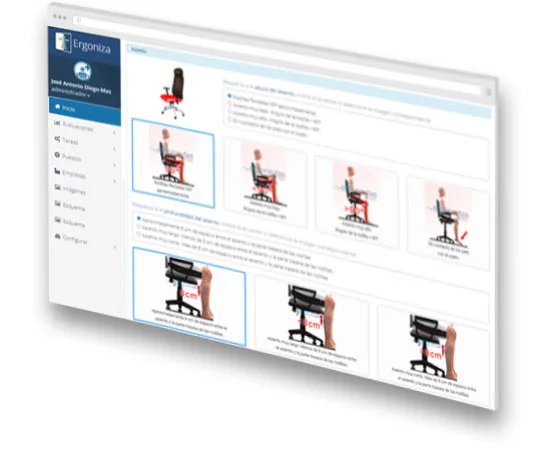
A cloud based software that integrates more than 20 tools for managing the ergonomics of the workstations in your company.
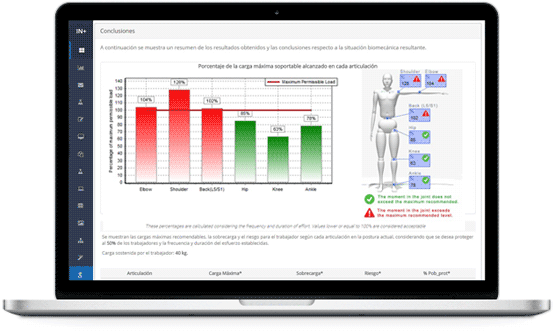
Evaluate all ergonomic risk factors of the workstations in your company: inadequate postures, repetitive movements, load handling, thermal environment...
Generate fully customizable reports in Microsoft Word or Adobe Pdf format.

Use Artificial Intelligence for automated posture detection from photographs or videos, or to automatically interpret your assessment results and obtain recommendations.
In a multiuser environment so that your company can have access to your data everywhere.
You only need a free account on Ergoniza
ERGONIZA allows you to use Artificial Intelligence for postural load assessment. Automatically capture workers’ postures from a photograph or a video and obtain an automated evaluation of the risk associated with inadequate or forced postures.
The Artificial Intelligence of ERGONIZA interprets the results of your assessments and automatically generates conclusions and recommendations.
AI in actionERGONIZA helps you manage the ergonomics of the workstations of your companies. Evaluate all the risk factors present in the workstations, manage the evaluations, and obtain editable and customizable reports.
You only need to register as a user of ERGONIZA to start testing.
Sign UpUnlock the full potential of Ergoniza. By becoming a Pro User you'll have access to all of Ergoniza and be able to use all of the online software without restrictions or time limits. You'll be able to use the results of evaluation methods and tools in your professional activity. You'll be able to print the results reports in pdf or Word and save your studies in files to open them later.
To register as a Pro user, you must first login to Ergoniza.
(*) In European Union countries, the price will be increased with the corresponding VAT.
(**) The price in american dollars has been calculated at the current exchange rate and may vary.
is a web by . Ergonautas is the specialized website in occupational ergonomics and ergonomic assessment of workstations at the . Ergonautas aims to be a useful support tool for the Occupational Risk Prevention and Ergonomics professional and people in training, providing rigorous technical information on occupational ergonomics, online tools for its application, research, training, and participation forums.
Ergonautas is formed by a large human team. In addition to technicians and programmers, the Ergonautas team is made up of researchers and professors from the Polytechnic University of Valencia. The team, led by José Antonio Diego Más, is at the forefront of research and teaching in ergonomics, teaching in official degrees and master's degrees, and developing research projects in the field of ergonomics and new technologies oriented towards humans.
If you need to know more, get in touch with Ergonautas
Or follow us on Linkedin
- - -
© 2006 - Universidad Politécnica de Valencia
 Ergoniza